815-727-0100


Understanding Pain and Suffering Damages in Personal Injury Cases
 Following a personal injury accident, there are generally two types of damages—economic and non-economic (sometimes known as special and general). Economic damages are straightforward, covering medical expenses, lost wages, and loss of future income. These are damages that have a specific number attached to them.
Non-economic damages (735 ILCS 5/2-1115.2) are usually called "pain and suffering," and are subjective, intangible losses like pain, suffering, emotional distress, and loss of enjoyment of life. Non-economic damages are often more difficult to quantify and may rely on expert testimony. Illinois law allows injury victims recovery for pain and suffering caused by another’s negligence, but the value of these damages can vary widely.
If you are dealing with constant pain or are unable to perform the day-to-day tasks you did before the accident, then pain and suffering damages are meant to compensate you for those losses. Insurance companies will try to downplay pain and suffering, but Illinois courts recognize that the human toll of an injury is often tied to the most significant loss. A Will County, IL personal injury attorney can determine what your pain and suffering damages are and then tell an insurance company or jury how pain and suffering has altered your life.
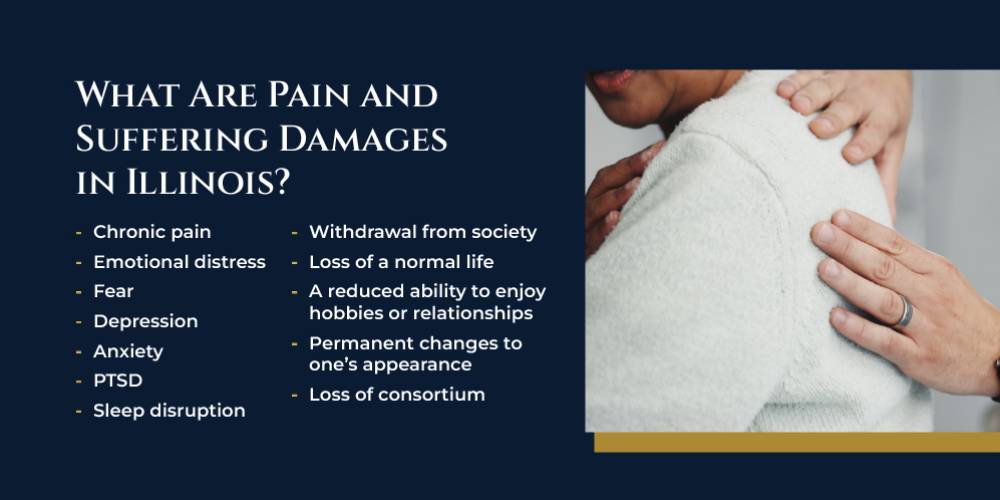
What Are Pain and Suffering Damages in Illinois?
Illinois uses a modified comparative negligence law, meaning an injured person can recover damages if he or she is less than 50 percent at fault, but the award will be reduced by the percentage of fault. Illinois generally does not cap non-economic damages, but caps do apply to claims against government entities.
To be eligible for both economic and non-economic damages when another’s negligence caused the injuries, four elements must be proven: the negligent party had a duty to others, that duty was breached due to carelessness or negligence, that breach of duty directly caused the injuries, and there are damages associated with those injuries. Non-economic damages include:
- Chronic pain
- Emotional distress
- Fear
- Depression
- Anxiety
- PTSD
- Sleep disruption
- Withdrawal from society
- Loss of a normal life
- A reduced ability to enjoy hobbies or relationships
- Permanent changes to one’s appearance
- Loss of consortium
How Do Illinois Courts Evaluate Pain and Suffering?
Illinois does not use a fixed formula by statute to calculate pain and suffering. The courts will consider a variety of factors, including the following:
Severity and Nature of the Injury
The court will consider whether the injuries are soft-tissue injuries, such as damage to the body’s muscles, tendons, ligaments, or fibrous tissues, which cause pain, swelling, bruising, and limited mobility, or injuries like broken bones. Visible injuries often increase credibility to insurers and juries, so when the injury is not visible, experts may be called on to detail how an unseen injury can be just as devastating as a visible one.
The Duration of Symptoms
In general, the longer the pain and suffering lasts, or is expected to last, the higher the potential value of the claim. Permanent injuries significantly increase the amount of damages, while injuries that are expected to heal within a relatively short period of time will not receive the same level of compensation.
Impact on the Victim’s Daily Life
If the victim of an accident can no longer work, exercise, drive, care for his or her children, or engage in hobbies enjoyed before the accident, then the pain and suffering damages are likely to be higher. Pain and suffering often have a profound effect on social and recreational activities, as well as family relationships; these changes must be taken into account.
Medical Documentation
The victim of injuries due to negligence who has pain and suffering must show a consistency in treatment with physician notes supporting ongoing pain to fully show the extent of the limitations. If depression, anxiety, and PTSD are included in pain and suffering, mental health providers must be consulted. Pain management specialists, orthopedists, and neurologists can also provide information regarding treatment and the effect of the pain and suffering on daily life.
Credibility and Testimony
The plaintiff will generally testify to the extent pain and suffering have impacted his or her daily life. His or her credibility is crucial. Family members, coworkers, and friends may also testify to how the accident has altered the plaintiff’s life and relationships. If emotional distress is involved, mental health providers can testify.
The Conduct of the Defendant
If the defendant showed recklessness or indifference to another’s life, then the pain and suffering damages may increase. Similarly, if the defendant was intoxicated at the time of the accident or if there were other aggravating circumstances, the amount of pain and suffering damages could be higher.
How Are Pain and Suffering Damages Calculated?
Insurers and attorneys often use the multiplier method to calculate pain and suffering damages. This method takes the total amount of economic damages (lost wages, medical expenses, ongoing medical expenses, and future lost wages) and then multiplies those damages by the level of severity of the pain and suffering damages. This is done by multiplying by a "severity multiplier" from 1.5 to 5. This method is most often used in cases where there are severe injuries.
The per diem method assigns a daily value to the victim’s suffering, then multiplies this value by the number of days of impact. This method works well when the pain and suffering have clear recovery timelines. In some cases, the amount of pain and suffering will be determined by reviewing verdicts from similar Illinois cases and considering jury tendencies by location (Cook County is known for higher awards).
What Pain and Suffering Damages Have the Highest Awards?







|815-727-0100


Results listed are not a guarantee or indication of future case results.